Ecomic — AI-assisted digital restoration of manuscripts
Biblioteca Nazionale Centrale di Roma
Web · Public Sector
2026
Creative direction, UX/UI design, prototype and front-end development
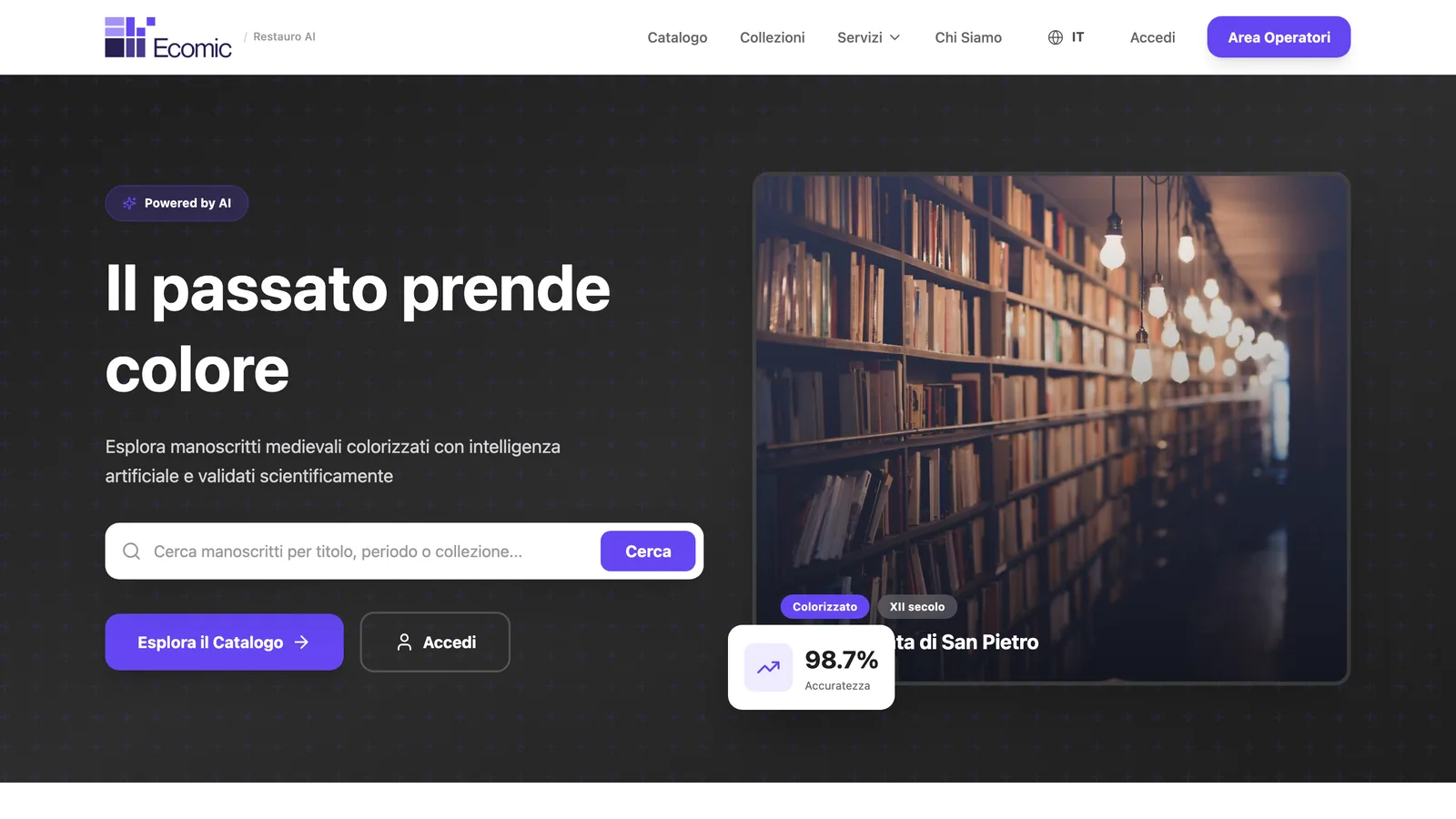
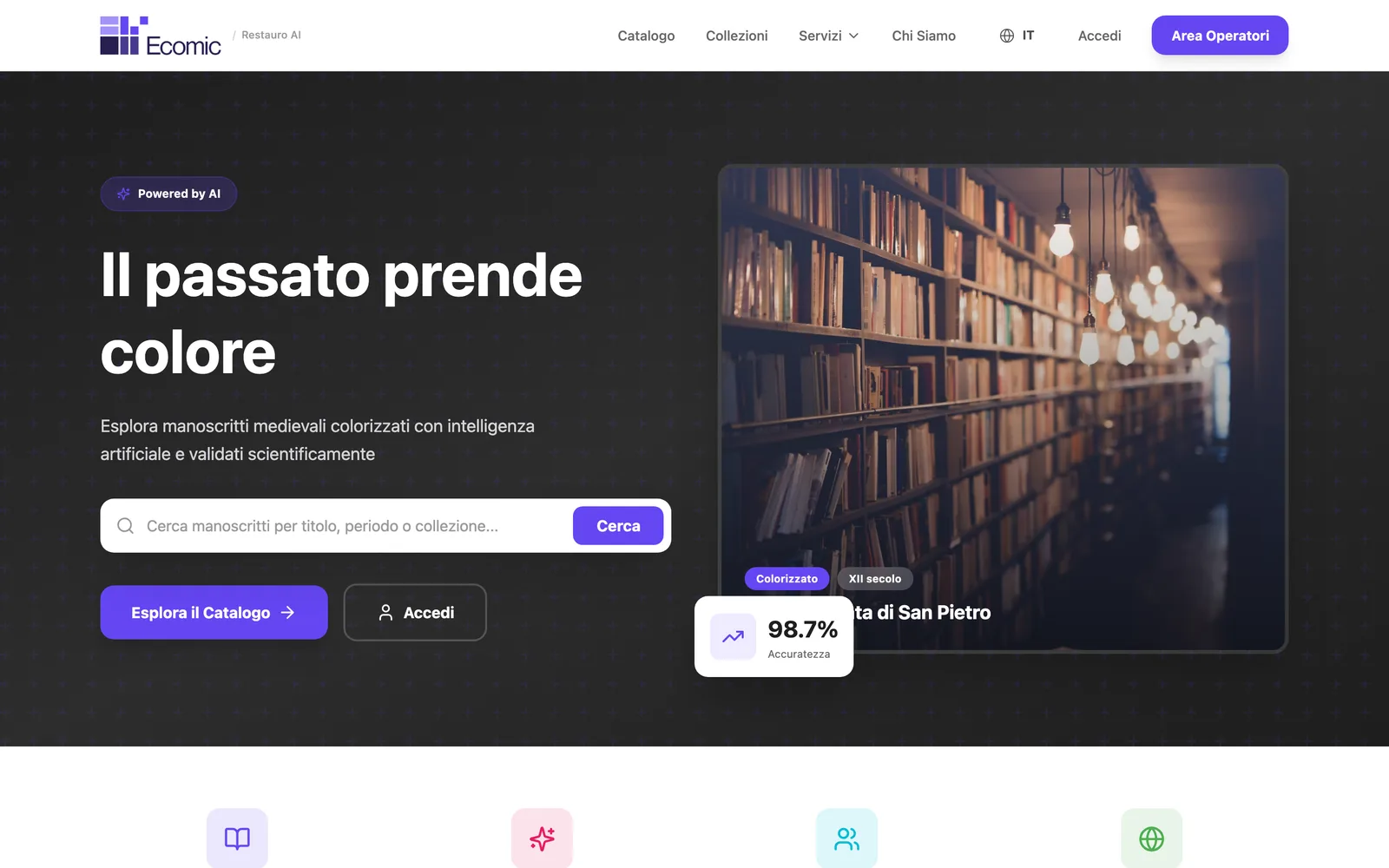
Ecomic is a digital ecosystem for preserving and opening up Italy's library heritage: a catalogue of digitised historical manuscripts, colourised with artificial intelligence and validated by palaeographers.
I took the project from creative direction through to front-end development, by way of UX/UI design and an interactive prototype, in collaboration with ALTAIR4 MEDIA SRL, for the National Central Library of Rome — Italian Ministry of Culture.
The project
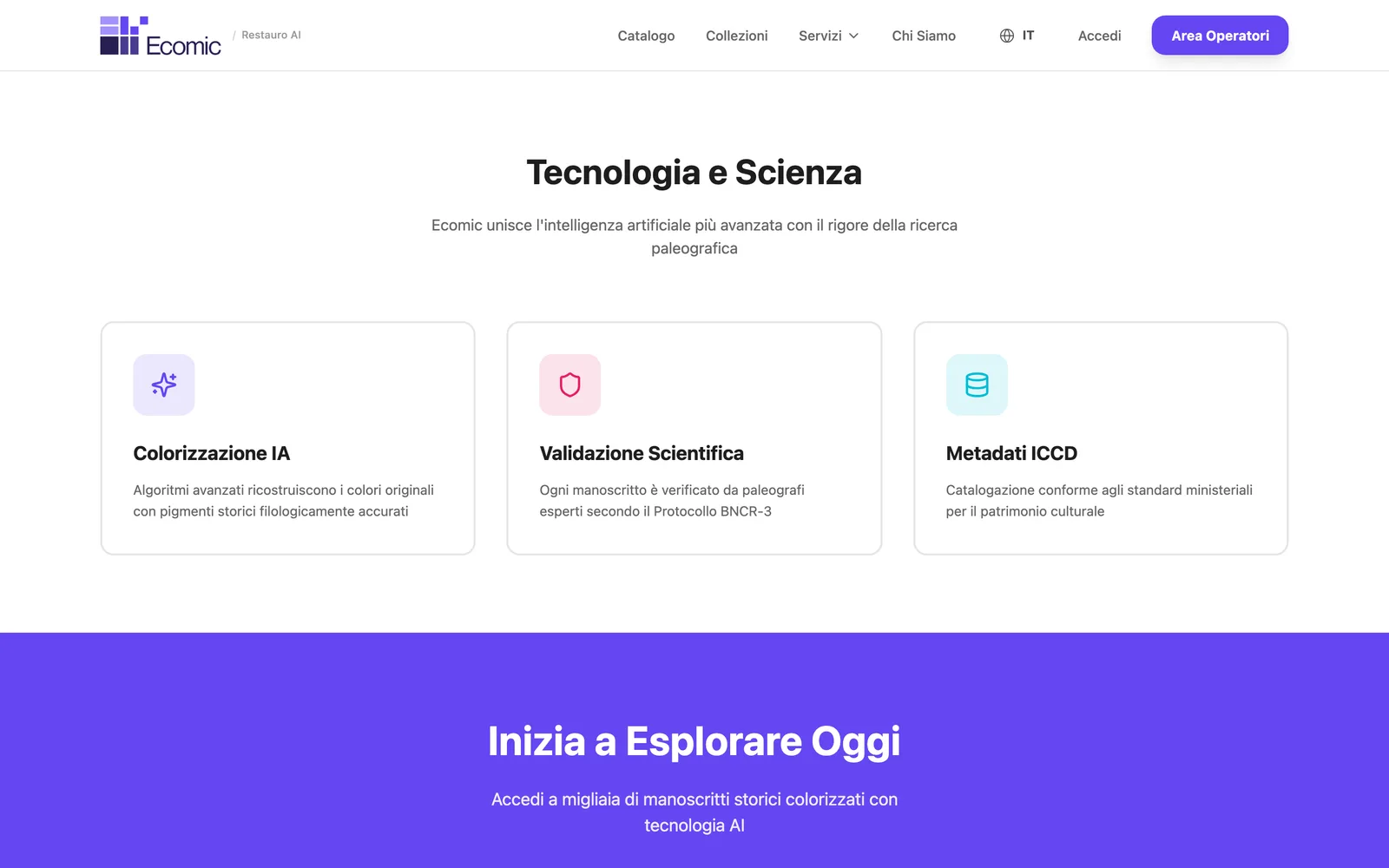
At the heart of Ecomic is assisted restoration: algorithms reconstruct the original colours of the codices using historically coherent pigments, backed by scientific review that validates every result against a protocol. Around that core sit the public catalogue, thematic collections, advanced search and a restricted area for library staff.
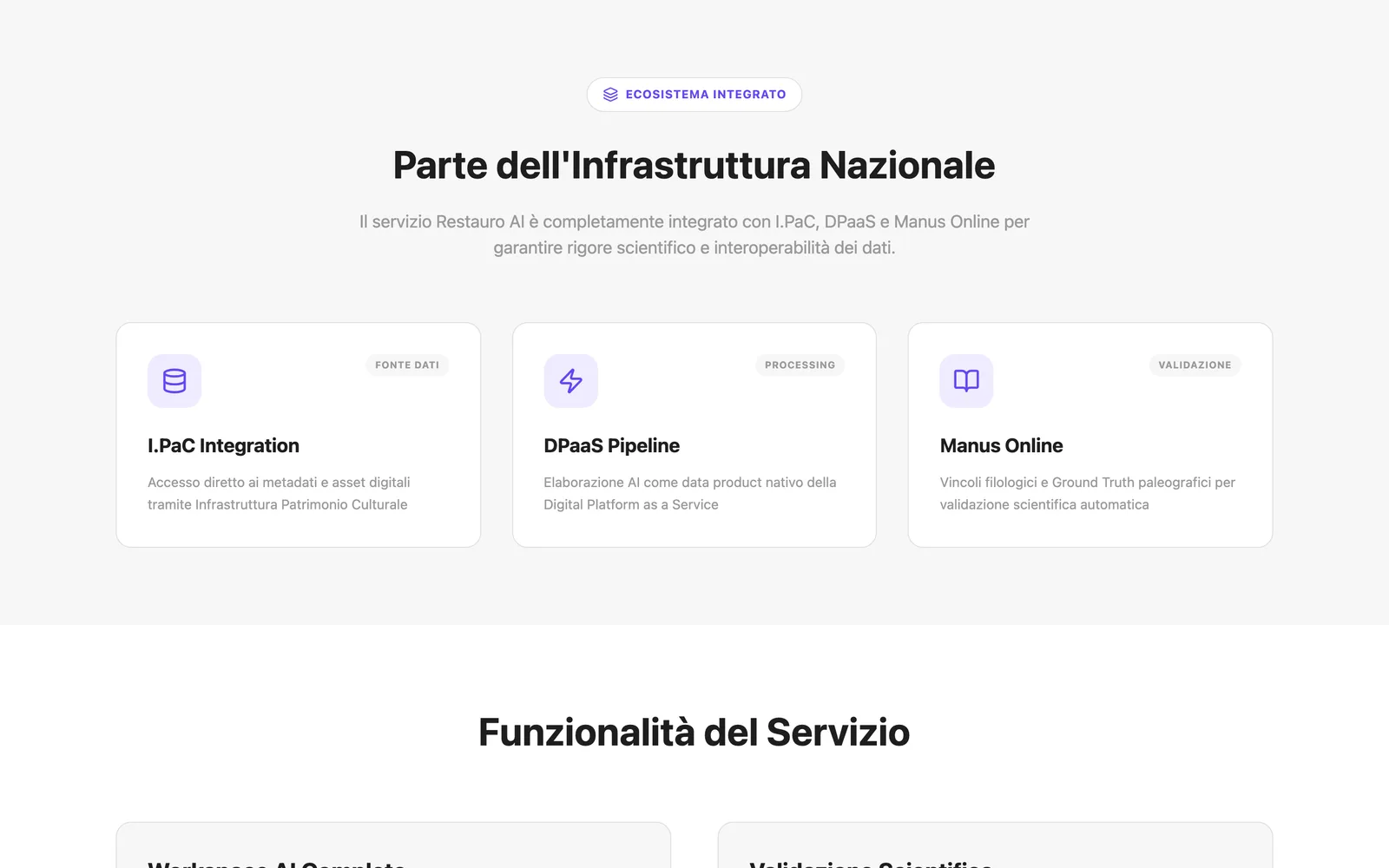
Cataloguing follows the ICCD ministerial standards, and the platform is built to fit into the existing digital ecosystem for cultural heritage.
The challenge
A public-sector cultural project has to serve two very different audiences.
On one side the citizen, the student, the researcher: they arrive out of curiosity or for study, and need to find, browse and understand without knowing any archival jargon. On the other the library operator, working in the platform every day, who needs dense tools, complete metadata and rigorous validation flows.
On top of that sits a tension typical of the field: the technology — the AI — is what makes the project distinctive, yet it must never cast doubt on the philological rigour of the result. If the interface looks like a toy, the scholarly community won't trust it.
The approach
I set the interface in an institutional but contemporary register: generous, legible typography, sharp hierarchy, plenty of breathing room around the content, and a single accent colour used sparingly to mark only what the AI has processed.
The main decisions:
- The manuscript first. Catalogue cards lead with the image and the data that actually matters — holding library, century, region, colourisation progress — instead of drowning it all in a table.
- Transparency about the AI. Every processed item is explicitly labelled, along with its scientific validation: users always know what they are looking at.
- Two ways in. Public access and the operator area live in the same architecture, without the complexity of the back office landing on the casual visitor.
- Search up front. The search bar is the first element after the opening statement: on a catalogue of thousands of items, that is the real entry point.
The operator area
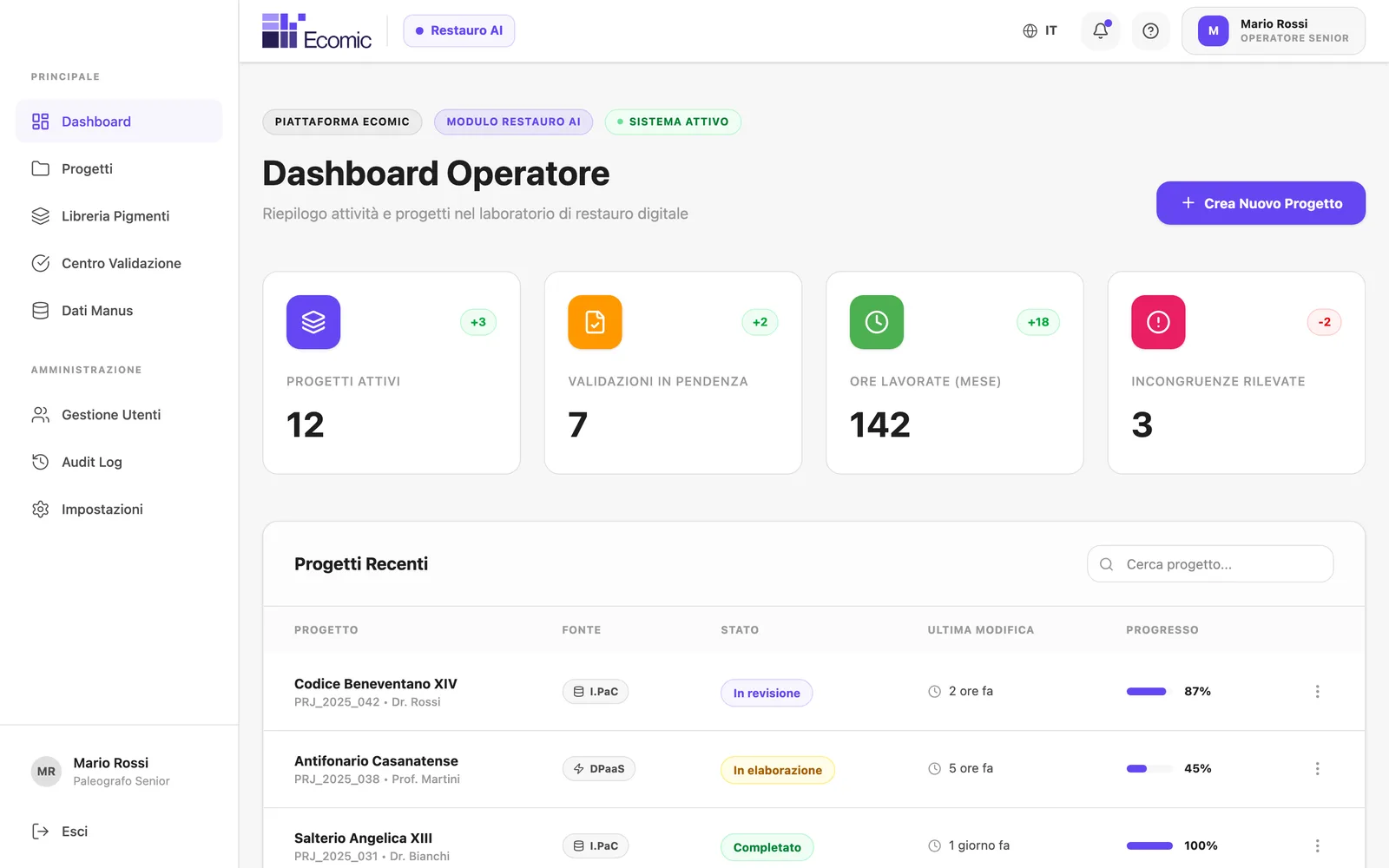
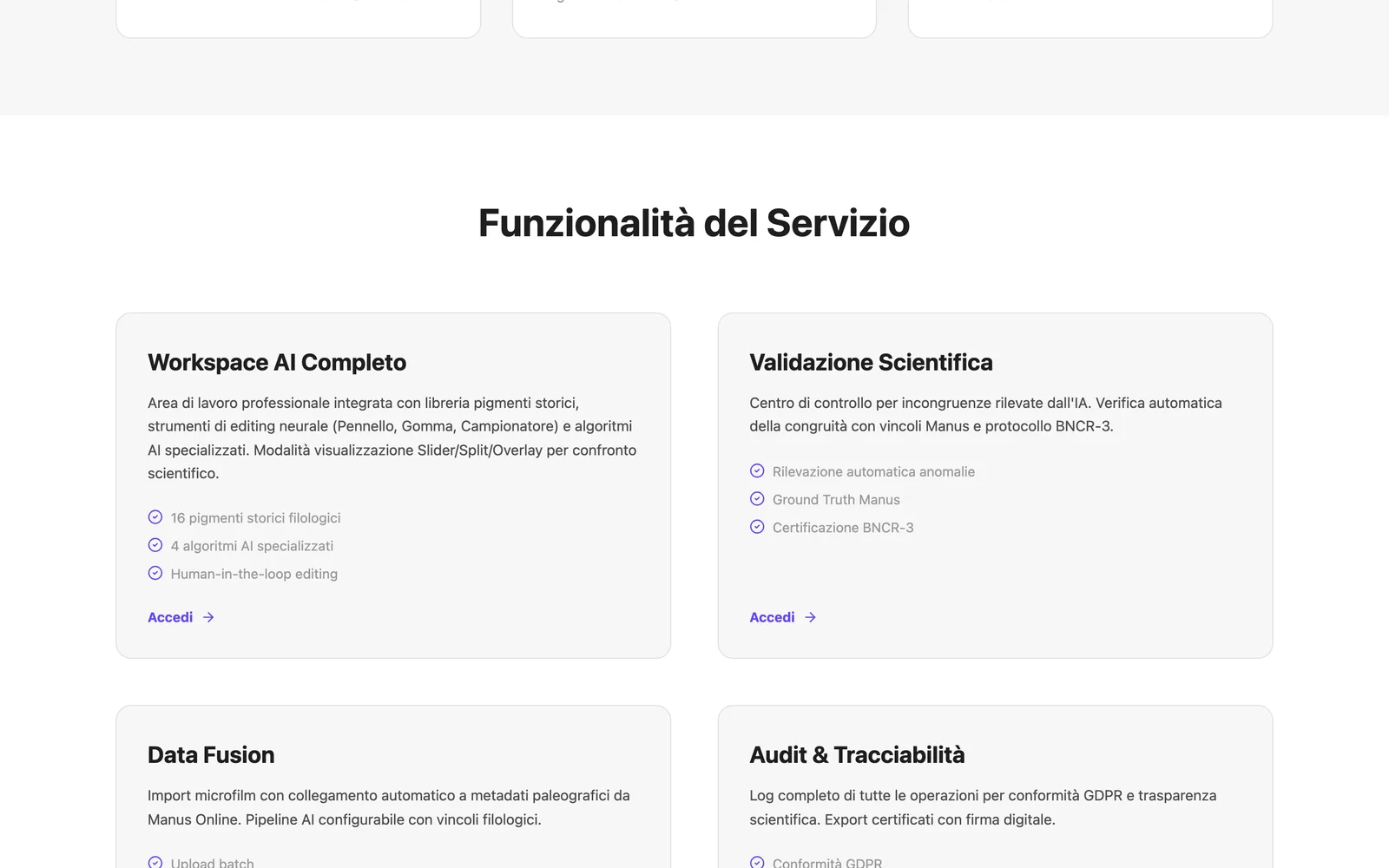
Behind the public catalogue sits the part where the actual work happens. The operator dashboard gathers restoration projects in progress with their status and page-by-page completion, pending validations and the inconsistencies flagged by the AI.
From there you reach the colourisation workspace — historical pigment library, editing tools and before/after comparison —, the validation centre and the audit log, which records every operation for scientific transparency and GDPR compliance.
I designed this side on the opposite principles to the public front: high information density, statuses legible at a glance — processing, under review, complete — and no decorative element taking space away from the data.
The workflow
A manuscript's journey passes through three stages, and the interface makes each of them explicit: acquisition of metadata and digital assets, AI processing of the colourisation, and validation against philological constraints and palaeographic Ground Truth.
It is a human-in-the-loop flow: the algorithm proposes, the operator corrects, and the result is certified only after human review. Every screen is built so it is always obvious where a manuscript stands and who did what — which, in a public archive, isn't a detail: it's the requirement.
The result
A platform with a coherent digital identity, now in use: the catalogue is open to the public, library staff work on the same foundation in the restricted area, and the role of artificial intelligence stays transparently declared on every processed item.
A project that holds together two things that rarely coexist in the cultural sector: a contemporary interface and the rigour the scholarly community demands.
Have a project in mind?
Tell me about it — I'll get back to you with a clear proposal, no strings attached.
Get in touch →