Claude Agentic Ecosystem Guide: API, Agent SDK, Claude Code, MCP, Hooks & Subagents Explained
How Anthropic's agentic architecture works: Claude API, Agent SDK, Claude Code CLI, Model Context Protocol (MCP), subagents, and governance hooks explained with clear diagrams and practical workflows.
Table of contents17 topics
Artificial Intelligence has reached an inflection point: the industry is shifting from reactive chatbots (asking a question and getting a block of prose) to Agentic AI, where models don’t merely generate text—they reason, execute bash commands, query databases, invoke APIs, and solve multi-step problems autonomously.
In this new paradigm, Anthropic has unveiled a suite of technologies that redefine engineering standards across the industry. Yet among developers, engineering leaders, and CTOs, confusion often persists:
- What is the difference between the Claude API and the Agent SDK?
- How does Claude Code CLI differ from standard IDE extensions?
- Why is the Model Context Protocol (MCP) being heralded as the “USB-C standard for AI”?
- How do Subagents communicate, and why are Hooks critical for safety?
In this comprehensive guide, we unpack Anthropic’s full agentic stack with intuitive metaphors, visual architecture diagrams, and production-tested workflows.
🗺️ The Ecosystem at a Glance
To visualize how these pieces fit together, consider the metaphor of an automated vehicle or advanced engineering crew:
| Component | The Metaphor | Technical Definition | Primary Audience | Production Example |
|---|---|---|---|---|
| Claude API | The Engine | Stateless HTTP endpoints to query models (Haiku, Sonnet, Opus) | Backend developers | Send structured prompts and receive text or JSON function calls (Tool Calling) |
| Agent SDK | The Chassis & Transmission | Software library orchestrating the decision loop (Reasoning Loop) | AI Agent engineers | Manage the ReAct loop: Think $\rightarrow$ Act $\rightarrow$ Observe $\rightarrow$ Self-Correct |
| Claude Code | The Field Engineer with the Toolkit | CLI terminal tool for software developers | Software & DevOps engineers | Reads local codebase, runs git commands, fixes compilation errors, and verifies unit tests |
| MCP (Model Context Protocol) | The Universal Connector (USB-C) | Open standard linking AI models to databases, files, and external APIs | Anyone building data integrations | Connects Claude to PostgreSQL, GitHub, or internal ERPs without custom bespoke scripts |
| Subagents | The Specialized Crew | Secondary agents with dedicated contexts managed by an orchestrator | Systems architects | The orchestrator delegates read-only code research to a subagent without polluting primary memory |
| Hooks | The Safety Relays & Automatic Reflexes | Interceptor functions running before or after tool executions | Security & DevOps teams | Block destructive terminal commands (rm -rf) or automatically format code after edits |
🏗️ Complete Agentic Architecture
The diagram below illustrates how a user request flows through the entire agentic stack:
flowchart TD
    User["Developer or Application"] -->|"Instruction or Task"| Orchestrator["Main Agent / Claude Code"]

    subgraph Core ["Reasoning Loop (Agent SDK / Claude API)"]
        Orchestrator -->|"Inference Request"| ClaudeModel["Claude 3.5 Sonnet / 3.7 Opus"]
        ClaudeModel -->|"Decision: Call Tool or Delegate"| Orchestrator
    end

    subgraph Safety ["Safety & Governance"]
        Orchestrator -->|"Pre-Tool Hook"| HookCheck{"Is Action Safe?"}
        HookCheck -->|"Yes"| ExecTool["Execute Tool Action"]
        HookCheck -->|"No"| Abort["Block Command / Require Human Approval"]
    end

    subgraph MultiAgent ["Multi-Agent Delegation"]
        Orchestrator -->|"Delegate Subtask"| Sub1["Subagent: Codebase Researcher (Read-Only)"]
        Orchestrator -->|"Delegate Subtask"| Sub2["Subagent: QA & Test Runner"]
    end

    subgraph DataConnectors ["Model Context Protocol (MCP)"]
        ExecTool -->|"Query via MCP Client"| MCPServer1["MCP Server: PostgreSQL DB"]
        ExecTool -->|"Query via MCP Client"| MCPServer2["MCP Server: GitHub / GitLab API"]
        ExecTool -->|"Query via MCP Client"| MCPServer3["MCP Server: Local File System"]
    end
1. Claude API: The Raw Intelligence Layer
The Claude API provides raw inference over HTTP REST. It processes text, system prompts, documents, images, and tool definitions, returning completions from Anthropic’s state-of-the-art model families:
- Claude 3.5 Sonnet: The undisputed industry benchmark for code synthesis, complex logical reasoning, and refactoring.
- Claude 3 Haiku: Extremely fast and cost-effective; ideal for triage, classification, and streaming micro-tasks.
- Claude 3 Opus: Designed for deep literary analysis, philosophical synthesis, and high-complexity reasoning.
Key Mechanism: Tool Calling (Function Calling)
Claude does not directly run external code via the API; instead, you provide a schema of functions your application supports (e.g., lookup_invoice(id) or create_stripe_refund(charge_id)). When queried, Claude replies with a structured JSON object specifying: “Execute create_stripe_refund with parameter charge_id: ch_12345”. Your backend executes the function and returns the result to Claude to close the loop.
2. Agent SDK: The Autonomous Reasoning Framework
While an API call is a single request-response cycle, the Agent SDK is the framework that grants autonomous persistence to the model.
An agent built on the Agent SDK implements the ReAct (Reasoning + Acting) pattern:
- Perceive: Parses the user goal and reads the environmental state.
- Plan: Determines which tool or subagent is required.
- Act: Executes the tool (e.g., queries an SQL database or edits a file).
- Observe: Inspects the outcome. If an error occurs (such as a failed test or missing parameter), it self-corrects and adjusts its plan until the objective is accomplished.
The SDK standardizes token management, context compression, error handling, and session persistence out-of-the-box.
3. Claude Code: The Autonomous Terminal Engineer
Introduced by Anthropic specifically for software developers, Claude Code is an agentic CLI utility that transforms Claude into an autonomous software engineer running directly inside your terminal.
Unlike traditional IDE auto-complete extensions:
- Claude Code interacts with your real filesystem and terminal shell.
- It indexes and understands the architecture of your entire repository without copy-pasting.
- It can create files, modify existing classes, run test suites (
npm test,pytest,flutter test), debug compilation errors, and stage git commits with meaningful commit messages.
4. MCP (Model Context Protocol): The Universal AI Standard
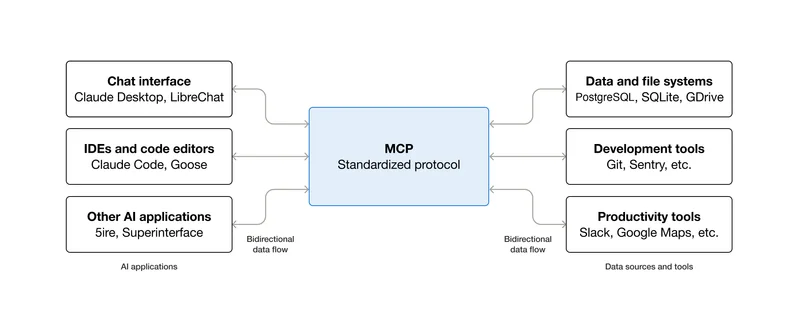
Prior to late 2024, integrating an AI assistant with external services required building bespoke adapters for every single combination:
    BEFORE MCP (M x N Fragmented Chaos):          WITH MCP (Universal Open Standard):

    Claude ──── Custom Adapter 1 ──── PostgreSQL        Claude ───┐
    ChatGPT ─── Custom Adapter 2 ──── GitHub            Cursor ───┼── [MCP Standard] ──┬── PostgreSQL
    Cursor ──── Custom Adapter 3 ──── Slack             Devin  ───┘                    ├── GitHub
                                                                                       └── Local Files
Anthropic open-sourced MCP (Model Context Protocol) to solve this integration fragmentation once and for all:
- MCP Host: The runtime client environment where the AI lives (e.g., Claude Desktop, Claude Code, Cursor, Antigravity).
- MCP Client: The protocol client module running inside the host.
- MCP Server: A lightweight server exposing data or actions from a specific resource (PostgreSQL, Google Drive, Vercel, Slack, or GitHub).
Once an MCP server is written for an enterprise database or API, any MCP-compliant AI client can immediately interface with it securely, without writing custom integration glue code.
5. Subagents: Scalable Multi-Agent Collaboration
When an agent is tasked with large enterprise objectives (e.g., “Audit the entire codebase, verify server security logs, and generate an executive PDF report”), assigning everything to a single agent causes severe friction:
- Context Window Degradation: The primary agent’s context quickly overflows with verbose raw logs, causing hallucination and lost instructions.
- Excessive API Costs: Sending hundreds of thousands of raw tokens through high-tier frontier models like Opus or Sonnet on every iteration is inefficient.
The architectural solution is Subagents:
- The Primary Orchestrator manages the overarching objective and roadmap.
- It delegates isolated tasks to specialized subagents:
- A Researcher Subagent operates in an isolated read-only sandbox to scan documentation and return a concise 10-line summary.
- A Test Runner Subagent executes the test harness and validates code diffs.
- The primary agent receives only the synthesized conclusions, keeping its context clean, laser-focused, and cost-efficient.
6. Hooks: Safety, Governance, and Lifecycle Automation
When an AI agent is empowered to execute terminal commands and modify files, security and governance become mission-critical.
Hooks are deterministic interceptors executed before or after an agent action:
1. Pre-Execution Hooks (Preventive Guardrails)
Execute before the tool action runs:
- Security Check: If the agent generates a dangerous shell command like
rm -rf /orDROP TABLE users;, the Pre-Hook catches the string, blocks execution, and requests explicit human confirmation (Human-in-the-Loop). - Token & Cost Limiter: Intercepts requests that exceed designated budget ceilings.
2. Post-Execution Hooks (Automated Pipeline Actions)
Execute immediately after the tool action completes:
- Code Quality: Every time an agent modifies a
.dart,.ts, or.pyfile, a Post-Hook triggers Prettier, Black, ordart formatautomatically. - Audit Trail: Logs every command and modification to an immutable ledger for enterprise compliance.
💡 Production Scenario: Autonomous Bug Remediation Workflow
Here is how all these technologies orchestrate in a real-world enterprise setup:
- A customer support ticket flags a transaction bug on the company’s CRM platform.
- The Main Orchestrator (powered by Claude 3.5 Sonnet) parses the error stack trace.
- The orchestrator queries server logs through a Postgres MCP Server to isolate the incident timeframe.
- The orchestrator launches a Researcher Subagent to locate the buggy controller in the repository.
- Claude generates a patch solving the logic error.
- A Pre-Execution Hook verifies that the patch does not touch sensitive environment variables or
.envsecrets. - Claude Code executes the automated test suite in an isolated Docker container.
- A Post-Execution Hook automatically opens a pull request on GitHub and pings the engineering team on Slack.
Tasks that formerly required hours of triage are safely handled in seconds.
🚀 Building Custom AI Agents and MCP Infrastructure
The transition to Agentic AI is not just about writing code; it is about re-architecting digital business operations to connect proprietary company assets with the world’s most capable foundation models.
As an engineering consultant and mobile architect:
- Custom MCP Server Development: Connect your databases, private APIs, and cloud services to Claude and Cursor securely.
- Autonomous Agent Workflows: Design and deploy multi-agent systems for tech teams, startups, and enterprises.
- Consulting & Implementation: Upskill development teams on Claude Code, Agent SDK, and robust AI safety architectures.
Ready to architect your agentic workflow? Get in touch for technical consulting.
Frequently Asked Questions
Does the Model Context Protocol (MCP) only work with Claude?
No. While designed and open-sourced by Anthropic, MCP is a completely open standard. Any model (including OpenAI GPT-4o, Google Gemini, or local models via Ollama) and any developer platform can implement MCP servers and clients.
Does Claude Code replace IDEs like VS Code or Cursor?
No. Claude Code operates alongside your favorite editor inside the terminal. You keep your editor open to observe code modifications while Claude Code manages multi-file edits, test executions, and git operations.
Do subagents increase overall API costs?
When architected correctly, subagents actually reduce total costs. They allow delegating low-complexity data filtering and search tasks to ultra-cheap models (such as Claude 3 Haiku), saving expensive frontier models (Sonnet or Opus) for high-level synthesis and architectural decisions.