🤖 AI for Doctors, Medical Clinics, Dentists & General Practitioners in 2026: From Ambient Scribing to Clinical Triage
Comprehensive guide to AI adoption in healthcare for 2026: ambient clinical scribes, dental radiographic computer vision, automated triage, and GDPR / EU AI Act compliance.
Table of contents10 topics
Anyone practicing medicine in 2026 faces a paradoxical reality: the more clinical medicine advances, the more patient care time is cannibalized by digital bureaucracy.
According to industry data, general practitioners (GPs), outpatient specialists, and dentists spend between 2 and 3 hours every single day typing notes into electronic health record (EHR) systems, transcribing diagnostic tests, processing prescription refills, navigating hundreds of patient messages, and filing administrative forms. The consequence? Screens acting as physical barriers between doctors and patients, diminished diagnostic empathy, and healthcare professional burnout at historical highs.
In 2026, the emergence of multimodal medical language models and Ambient Clinical Scribes (ambient listening assistants) is radically transforming healthcare workflows. Artificial Intelligence does not replace clinical intuition, nuanced judgment, or diagnostic responsibility: it eliminates low-value clerical typing and repetitive administrative overhead, allowing practitioners to return to what they trained for: listening to patients and looking them in the eye.
In this practical guide, we examine how doctors, group practices, dentists, and primary care physicians are successfully deploying AI in 2026, covering field-tested platforms, ambient voice scribing workflows, dental X-ray analysis, and mandatory compliance with GDPR, HIPAA, and the EU AI Act.
📊 Comparison Matrix: Leading Healthcare AI Tools & Platforms in 2026
| Software / Platform | Target Practitioners | Core Capability | EHR / Practice Software Integration | Privacy Compliance (GDPR / HIPAA) | Pricing Model |
|---|---|---|---|---|---|
| Nabla Copilot | Specialists, GPs, Polyclinics | Ambient encounter listening with structured SOAP note generation in under 10 seconds | ✅ Direct API connectors with major EHR systems | 🇪🇺 EU data centers, local de-identification, zero data training | From approx. €79 / clinician / month |
| Heidi Health | GPs, Pediatricians, Physical Therapists | Multi-specialty ambient scribe with customizable templates and referral letter builder | ✅ Web extension, native desktop & mobile apps | 🇪🇺 GDPR & HIPAA compliant with signed DPA | Freemium tier available; Pro from $59 / month |
| Pearl Dental AI | Dentists, Orthodontists, Periodontists | Computer vision for bitewings & panoramas: automatic detection of caries, bone loss, and calculus | ✅ Native plugin for imaging software (Carestream, Vatech, Dentsply) | 🇪🇺 CE-marked Medical Device & GDPR compliant | Monthly SaaS subscription per operatory |
| Corti | Triage Centers, Urgent Care, Group Clinics | Real-time audio analysis during patient triage calls to detect emergency cues and clinical risk | ✅ VoIP PBX and healthcare CRM integration | 🇪🇺 Full compliance with strict EU health data regulations | Custom enterprise quote per clinical volume |
| Doctolib AI / MioDottore Assistant | Private Clinics, Dentists & Family Doctors | Automated prescription refills, patient self-triage, and AI-assisted scheduling messaging | 🏆 Native deep integration with clinic booking calendar | 🇪🇺 Full GDPR compliance within European cloud | Add-on module to practice management suite |
🎙️ 1. Ambient Clinical Scribes: How AI Listens to Encounters and Documents the EHR
The single most transformative healthcare technology of recent years is Ambient Clinical Scribing.
Forget the awkward dictation software of the 2010s (“Period, new paragraph, quote, patient presents with acute cephalalgia”), which forced doctors to speak like robots after the consultation ended. Modern ambient clinical scribes powered by medical-grade LLMs and fine-tuned speech models (such as Whisper Health):
- The doctor places a smartphone or tablet on the desk and taps “Start Consultation”.
- The microphone listens to the natural, conversational interaction between physician and patient, filtering background room noise and separating speakers (speaker diarization).
- The patient may speak in colloquial terms, tell irrelevant stories, or jump between topics: the AI filters out small talk and extracts only clinically meaningful data points.
- Within 5 to 10 seconds of concluding the encounter, the system produces a rigorously formatted SOAP note (Subjective, Objective, Assessment, Plan), ready for review, electronic signature, and one-click transfer into the clinic EHR.
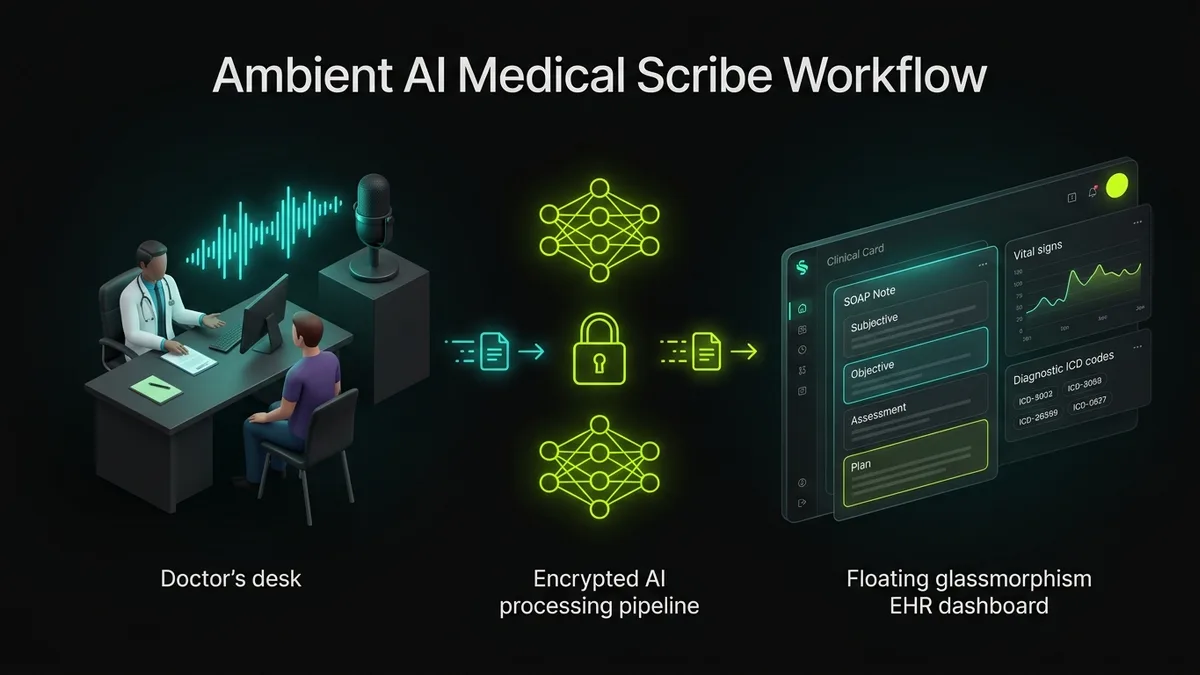
Real-World Example: From Conversation to Structured SOAP Note
Here is an actual clinical dialogue captured by an ambient scribe and what it produces in seconds:
Recorded Natural Consultation:
Doctor: “Mrs. Davies, tell me: how has that pain in your right knee been doing since we last spoke?”
Patient: “Doctor, it feels slightly better in the mornings, but whenever I walk down the stairs to do grocery shopping I feel a sharp pinch and some swelling. I’ve been taking paracetamol, but only when it gets unbearable, maybe once every two or three days.”
Doctor: “Understood, let’s have you on the examination table… there is slight suprapatellar fullness on the right. When flexing past 90 degrees, tenderness is elicited along the medial joint line. Let’s continue paracetamol as needed, but I want to order an MRI of the right knee without contrast to rule out a meniscus tear.”
AI-Generated Clinical Documentation (SOAP Format in 6 seconds):
- S (Subjective): Patient reports persistent right knee pain over the past 4 weeks, aggravated by descending stairs and moderate weight-bearing activity. Notes episodic mild swelling. Currently manages pain with PRN paracetamol (approx. 1 tablet q48-72h) with partial symptom relief.
- O (Objective): Physical examination of right knee: mild suprapatellar effusion noted. Focal tenderness along the medial joint line upon palpation. Full passive ROM, but localized medial joint pain upon forced flexion beyond 90°. Ligamentous testing intact.
- A (Assessment): Suspected medial meniscus tear of the right knee in the setting of early localized osteoarthritis.
- P (Plan): Non-contrast MRI of the right knee ordered. Continue symptomatic therapy with Paracetamol 1000 mg PO PRN (max 2g/day) with meals. Clinical re-evaluation scheduled upon imaging review.
💡 Best Practice Rule: AI-generated documentation must never enter the electronic health record without clinician validation. The golden standard is always Human-in-the-Loop: the doctor spends 10 seconds scanning the bullet points, verifying medication dosages, and clicking “Approve & Sync”.
🦷 2. AI in Dentistry: Radiographic Vision and Treatment Plan Acceptance
In dental practices, the impact of Artificial Intelligence extends far beyond text transcription and penetrates the diagnostic core: automated radiographic image analysis (2D Bitewings, Panoramic OPGs, and 3D CBCT scans).
FDA-cleared and CE-certified medical platforms such as Pearl AI Dental and Diagnocat analyze dental imagery in real time as soon as digital sensors or phosphor plates upload the capture:
┌────────────────────────────────────────────────────────────────────────┐
│                   DENTAL AI: VALUE CREATION IN PRACTICE                 │
├───────────────────────────────────┬────────────────────────────────────┤
│   FOR THE CLINICIAN               │   FOR THE PATIENT                  │
├───────────────────────────────────┼────────────────────────────────────┤
│ • Zero missed incipient inter-    │ • Instant visual comprehension:    │
│   proximal caries lesions         │   clear color-coded tooth overlays │
│ • Millimeter-precise periodontal  │ • Overcomes treatment skepticism   │
│   bone loss measurements          │   ("Is the dentist over-treating?")│
│ • Rapid detection of periapical   │ • Case acceptance rates increase   │
│   radiolucencies & pulp stones    │   by up to +35%                    │
└───────────────────────────────────┴────────────────────────────────────┘
The “Objective Second Opinion” that Builds Patient Trust
One of the persistent communication challenges in dental practice is patient skepticism: when a dentist points to an asymptomatic tooth on a grainy black-and-white radiograph and advises treating an interproximal lesion or scaling a deep pocket, patients often hesitate or postpone care.
By projecting the radiograph onto the operatory chairside monitor with an objective AI visual overlay (e.g. magenta bounding contours highlighting enamel/dentin decay depth, yellow markers tracking bone margins), the diagnosis becomes transparent and incontestable. Clear visual presentation remains the single most effective driver of true informed consent.
🩺 3. General Practice & Primary Care: Conquering the Administrative Avalanche
For primary care doctors and family practices, daily workloads frequently reach crisis levels: handling 70 to 120 patient interactions per day across telephone triage, asynchronous portal messages, email inquiries with messy PDF attachments, and repetitive prescription renewals.
In 2026, healthcare AI platforms streamline primary care across three operational bottlenecks:
A. Intelligent Message Triage & Prescription Renewals
Instead of distributing private phone numbers or managing chaotic inboxes, modern practices utilize encrypted portals equipped with conversational AI triage:
- Routine Repeat Prescriptions: Patients select recurring medications from their active therapeutic chart. The AI validates prescription history against historical dosages, checks safe refill intervals, and prepares electronic prescription drafts for one-click batch approval by the physician at day’s end.
- Emergency Triage Routing: If a patient types “I feel a heavy crushing pressure in my chest radiating to my jaw and I am sweating cold”, the AI immediately aborts the chat, displays high-priority emergency instructions to call emergency services (911 / 112 / 999), and instantly alerts practice staff.
- Administrative Inquiries: Routine non-clinical queries regarding clinic hours, lab results availability, and vaccination appointment logistics are resolved 24/7 without burdening front-desk receptionists.
B. Discharge Summary & Hospital Record Synthesis
When a complex chronic or geriatric patient returns from inpatient hospitalization with a dense multi-page discharge summary loaded with acronyms and lab panels, clinicians can feed the document into a privacy-guaranteed medical AI model:
- Instant extraction of the reconciled home medication list;
- Automated highlighting of therapeutic modifications (e.g. “ACE inhibitor discontinued, Angiotensin Receptor Blocker + thiazide initiated”);
- Chronological checklist of follow-up labs scheduled at 30 and 60 days.
⚖️ 4. Privacy, GDPR, HIPAA, and the EU AI Act in 2026
Healthcare is the most rigorously regulated sector on earth, and rightfully so. When evaluating AI systems for a clinical environment, compliance cannot be an afterthought.
⚡ Crucial Warning: Inputting patient names, ID numbers, medical histories, or identifiable clinical scans into standard public consumer LLMs (like consumer ChatGPT or generic web tools) constitutes a severe privacy breach under GDPR Article 9 (Special Category Data) and HIPAA, exposing clinics to multi-million-euro regulatory penalties and professional licensing sanctions.
Every healthcare AI software implemented in 2026 must satisfy three technical criteria:
- Zero Data Retention & No Model Re-training: The AI software provider must execute a formal Data Processing Agreement (DPA) or Business Associate Agreement (BAA) stipulating that clinical voice recordings, transcripts, and radiographs are never retained or utilized to train general foundation models.
- On-Device or Edge De-Identification: Advanced clinical solutions apply local redaction filters before transmission: patient identifiers (names, dates of birth, contact numbers, residential addresses) are masked on the local machine with synthetic placeholders ([PATIENT_1], [LOCATION_A]).
- EU AI Act & Medical Device Regulations: The European Union AI Act classifies software utilized to formulate medical diagnoses or steer therapeutic decisions as High-Risk AI Systems. This mandates CE Medical Device Certification (MDR), regular algorithmic audit trails, and strict enforcement of the Human-in-the-Loop principle: AI acts strictly as an advisory copilot; legal and diagnostic responsibility remains 100% with the licensed clinician.
🎯 5. How to Introduce AI into Your Medical Practice: A 4-Step Roadmap
For dental clinics, multi-specialty practices, or independent physicians looking to reclaim several hours each week without operational disruption, this phased roadmap delivers smooth implementation:
- Phase 1: Start with Ambient Scribing (Weeks 1–2).
Activate a trial with a validated ambient clinical scribe (such as Nabla Copilot or Heidi Health). Begin using it for 3–4 routine consultations per day to calibrate your preferred SOAP formatting. You will immediately recover your lunch break and avoid evening chart catch-ups. - Phase 2: Automate Repeat Inquiries & Refills (Weeks 3–4).
Integrate digital prescription renewal and structured appointment triage through your practice website or patient portal, gently transitioning patients away from unstructured personal messaging. - Phase 3: Deploy Specialized Computer Vision (Month 2).
If operating a dental or aesthetic clinic, connect an AI radiographic diagnostic overlay. Utilize chairside visual screens during initial exams to visually articulate treatment necessity. - Phase 4: Tailored Practice Integrations (Month 3+).
For growing medical centers and polyclinics, consider engineering custom software integrations and autonomous AI agents that connect appointment scheduling, EHR notes, and billing pipelines into a unified, zero-friction infrastructure.
Artificial Intelligence does not distance physicians from their patients: when deployed correctly, it returns to healthcare professionals the most precious asset of all—the time to listen with care and diagnostic focus.
💡 For HealthTech Startups & Healthcare Software Vendors:
If your company engineers certified clinical software, ambient documentation engines, or medical computer vision tools and you would like to explore technical reviews or featured benchmarks, please visit our Editorial Partnerships page.