Native Mobile App (Flutter) vs Web App (PWA): Which One to Choose in 2026?
Comprehensive comparison between native mobile apps (Flutter/iOS/Android) and Progressive Web Apps (PWA) in 2026: technical differences, development costs, user retention, push notifications, and app store economics.
Table of contents13 topics
Whenever a company, startup founder, or product team decides to launch a new digital product, the foundational architectural question immediately emerges: “Should we build a native mobile app for iOS and Android, or will a responsive Web App or Progressive Web App (PWA) suffice?”
In 2026, this architectural crossroads is more nuanced than ever. On one hand, modern Web Apps and PWAs have achieved unprecedented performance, caching capabilities, and instant URL access; on the other hand, cross-platform native frameworks—principally Flutter powered by its Impeller rendering engine—deliver guaranteed 120 FPS silky animations, total smartphone hardware control, bulletproof background notifications, and the distribution credibility of Apple’s App Store and Google Play.
Making the wrong bet at the beginning can be catastrophic: spending €30,000 and six months engineering a complex native app when a simple web portal was all that was needed drains vital runway; conversely, launching a web app when your core value proposition requires background geofencing, hardware Bluetooth, or instant push alerts will cripple customer retention.
In this practical guide, we dissect the technical trade-offs, real-world development budgets, user acquisition funnels, and concrete decision matrices to determine whether a Web App or a Native Mobile App makes sense for your business in 2026.
📊 Comparison Matrix: Native Mobile App (Flutter) vs. Web App (PWA)
| Metric / Capability | Native Mobile App (Flutter) | Responsive Web App / PWA |
|---|---|---|
| Distribution Channel | 🛍️ Distributed through Apple App Store & Google Play | 🌐 Instantly accessible via any standard web browser URL |
| First-Time Access Friction | ⚠️ Higher friction (requires store search, authentication, and install) | 🏆 Zero friction (one click from a link, social post, or QR code) |
| Frame Rates & Fluidity | 🏆 Solid 120 FPS, native GPU rendering with Impeller | 🟡 Good, but constrained by browser JavaScript engine overhead |
| Offline Performance | 🏆 Flawless & resilient (embedded SQLite, Isar, background sync) | ⚠️ Limited (relies on browser Service Workers and local cache quotas) |
| Push Notifications | 🏆 100% Reliable across iOS (APNs) and Android (FCM) | ⚠️ Supported on Android; historical friction and opt-in barriers on iOS Safari |
| Device Hardware Integration | 🏆 Unrestricted: Bluetooth BLE, NFC, FaceID/Biometrics, Camera ISP, background geofencing | ⚠️ Basic: standard camera feed and active geolocation; no deep background hardware polling |
| Initial Time-to-Market & Cost | Moderate-High (single Flutter codebase for iOS/Android, but App Store review required) | 🏆 Fastest and leanest (deploy instant web code directly to cloud hosting) |
| Deployment & Updates | Requires compiling binary builds and waiting for store review approval | 🏆 Instantaneous (push Git commit, live across all users in seconds) |
| Monetization & Payment Processing | In-App Purchases subject to 15-30% Apple/Google platform fees (Stripe for physical goods) | 🏆 Standard Stripe / PayPal payment gateways with 1.4% - 2.5% merchant fees |
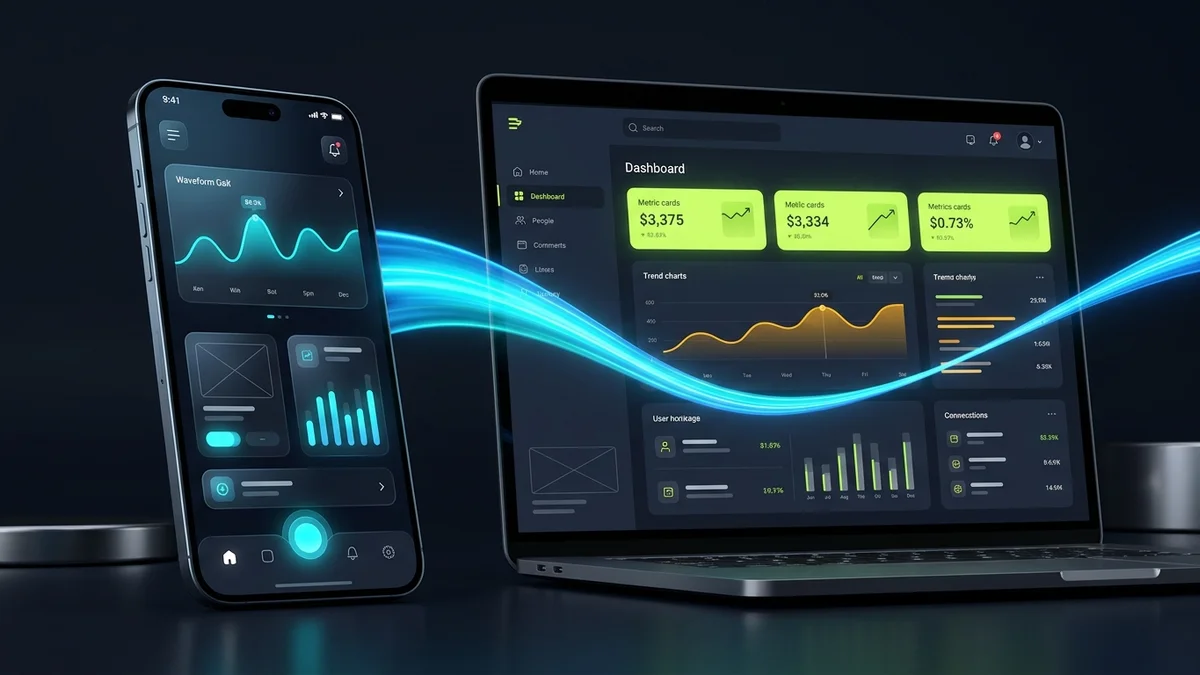
📱 What is a Native Mobile App (and How Flutter Redefined Cross-Platform)?
Historically, building “native” apps required two distinct engineering teams: Swift developers for iOS and Kotlin developers for Android. This doubled payroll, introduced feature divergence, and lengthened release schedules.
In 2026, cross-platform mobile engineering has matured around Flutter, Google’s open-source UI software development kit. Thanks to its modern Impeller rendering engine, Flutter completely sidesteps JavaScript bridges, compiling directly into native ARM 64-bit machine code.
When a Native Mobile App is NON-NEGOTIABLE:
- Direct Smartphone Hardware Integration: If your solution communicates with Bluetooth medical equipment, IoT sensors, fitness wearables, thermal receipt printers, NFC access control tags, or tracks continuous background GPS for logistics and dispatch while the device is locked in a pocket.
- Push Notifications Drive Customer LTV: For messaging, live trading, ride-hailing, food delivery, or real-time community apps, instant re-engagement is essential. On iOS, Web App push notifications require users to manually tap “Add to Home Screen” and navigate permission dialogs that over 80% of consumer users fail to complete.
- Mission-Critical Offline Reliability: If field technicians, warehouse auditors, or airline passengers need to log inspections or access documents completely severed from cell towers, an app backed by a local SQLite engine provides dependability a browser sandbox cannot match.
- Brand Trust and App Store Discoverability: For fintech, healthcare, insurance, or premium subscription clubs, verified presence on Apple’s App Store with verified five-star ratings carries immediate consumer trust that a raw web domain struggles to evoke.
🌐 What is a Web App (PWA) and When is it the Winning Choice?
A Web App is an interactive software application rendered entirely within a web browser (built on modern frameworks like Astro, Next.js, React, or Vue). When engineered as a Progressive Web App (PWA), it incorporates a web app manifest and Service Worker script, allowing users to bookmark it to their mobile home screen with a branded icon and full-screen display.
When a Web App is the STRATEGICALLY SUPERIOR Move:
- MVP Market Validation: If you need to test market willingness to pay before committing €20,000+ to custom app store builds, a Web App lets you ship a production prototype in three to four weeks.
- B2B SaaS & Management Portals: Complex enterprise tools—ERP dashboards, invoicing platforms, CRM suites, and inventory management—are used 90% of the time on desktop monitors with physical keyboards and mice. Building a native mobile app for a B2B SaaS is only justified as a lightweight companion app, not as the primary product.
- Digital Subscriptions Without Store Tax: Apple and Google collect up to 30% on digital subscriptions processed through In-App Purchases. On a Web App, you can connect Stripe directly and retain 97% of your revenue, paying only standard interchange transaction fees.
- Organic Search Engine Optimization (SEO): Native app code is locked behind store walls—Google search bots cannot index screens inside your app. A Web App indexes seamlessly, capturing high-intent organic search queries and allowing instantaneous social sharing across messaging apps.
🎯 The 4-Question Decision Framework
Before approving development contracts, run your concept through these four litmus tests:
[Question 1: How frequently will the user interact with the service?]
  ├─► Once a month / Sporadically? ──► Choose WEB APP (Nobody keeps an app they open twice a year)
  └─► Multiple times daily / Weekly? ──► Proceed to Question 2

[Question 2: Do you require deep hardware sensors, Bluetooth, or background GPS?]
  ├─► No, standard forms and dashboards suffice? ──► Proceed to Question 3
  └─► Yes (BLE devices, geofencing, biometric auth)? ──► Choose MOBILE APP (Flutter)

[Question 3: Does your business rely on instant Push Alerts for retention?]
  ├─► Yes, real-time push re-engagement is vital? ──► Choose MOBILE APP (Flutter)
  └─► No, transactional email / SMS is sufficient?  ──► Proceed to Question 4

[Question 4: What is your timeline and capital constraints?]
  ├─► Budget < €8,000 and launch needed within 30 days? ──► Choose WEB APP
  └─► Sufficient capital allocated to scale on App Stores?  ──► Choose MOBILE APP (Flutter)
💡 The “Dual-Track” Strategy: Web First, Mobile Second
For the startups and growing companies I consult with, the highest-ROI playbook is rarely an either-or dogmatism—it is an orchestrated phased roadmap:
- Phase 1 (Months 1–2): Build an agile, responsive Web App on a decoupled API-first backend. Validate customer demand, onboard your first paying cohort, and generate cash flow without paying platform commissions.
- Phase 2 (Months 3–5): Leveraging the exact same production API endpoints, build the native Flutter mobile application. Invite your most engaged power users to download the app for real-time push notifications, zero latency, and dedicated mobile UX.
This staged approach mitigates over 80% of entrepreneurial development risk, ensuring capital is deployed into store optimization only after product-market fit has been mathematically proven.
❓ Frequently Asked Questions (FAQ)
Can Flutter truly compile to both Mobile and Web from a single codebase?
Yes. Flutter natively targets iOS, Android, Web, macOS, and Windows from a shared Dart codebase. However, desktop web interfaces require distinct navigational ergonomics (mouse hover states, keyboard shortcuts, multi-column grids) compared to handheld mobile touchscreens. The recommended architectural pattern is sharing core business logic, models, and API calls while tailoring UI widget presentations for mobile vs. desktop viewports.
How much does it cost to publish an app on Apple and Google stores?
Google Play requires a one-time developer registration fee of $25. The Apple Developer Program requires an annual fee of $99 per year (or $299 for enterprise distribution). In addition, mobile apps must navigate Apple’s App Review process, which verifies privacy, security, and human interface guidelines.
Do mobile users actually prefer native apps over mobile websites?
Empirical user data reveals that mobile device users spend more than 88% of their mobile screen time inside native mobile apps rather than mobile web browsers. However, users exhibit high resistance to installing new applications unless they anticipate frequent, recurring utility. For occasional interactions, users prefer the web; for daily tools, they demand an app.
Can I transition a Web App into a Native Mobile App later without rewriting everything?
Yes. If the Web App was engineered with a modern headless architecture (separating the frontend presentation layer from backend REST or GraphQL APIs), building a Flutter mobile app simply involves pointing the new mobile client at your existing backend. User databases, authentication tokens, and business logic remain completely intact.
🚀 Conclusion
There is no universally superior technology—only the right technological choice aligned with your business model, customer interaction frequency, and available capitalization.
Want to explore the costs and architecture of your digital roadmap?
- 📱 How Much Does It Cost to Build a Mobile App in 2026?
- ⚡ Make vs. Zapier vs. n8n: Choosing the Right Automation Stack
- ⚖️ European Accessibility Act (EAA): Website & E-commerce Compliance Guide
If you are evaluating an app concept and need an objective, transparent technical assessment of whether a Web App or a Flutter Mobile App makes commercial sense, reach out directly to discuss your project.